Twitter learning curve

I think I’m beginning to understand Twitter, and I managed to deplete my 250 Twits SMS’s. You really need the desktop client when on the internet. And only use the Mobile SMS when, Mobile. Doh!

What I have found are interesting conversations with people I know, what I don’t understand is people who are following me, who do not know me, and I have never meet. What value following me? The first thing that comes to mind are squirrels gathering nuts, (me being the nut in this scenario) but I’m sure I will find out my role here.

One other thing, picking a desktop Twitter client has been interesting as I use a PC in the office and a Mac at home, and a Palm T/X and Nokia 6300 as mobile. Choices…

Google Maps API?

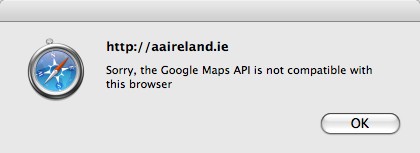
I love this, in this day and age that a API for the Internet is not written to comply with standards. This message below is unacceptable!


But I’ll place the blame on aaireland.ie As you can see this is a Safari Browser error message, but I am betting that the AA Roadwatch folks have coded this web page for IE only usage. BAD! BAD! BAD! But further accusing Google for causing this incompatibility should net them a rebuke from Google.

Twitter and Jaiku performance issues

One thing I’ve noticed about Twitter and Jaiku, is a common thread in IT, Scaleability! It’s an issue that I worked on in my days with AT&T Wireless. Mobile phone vendors have been dealing with SMS and voice connection transactions for many years and the volume of such transactions have only grown over the years since I had to deal with 25+ million transactions per day. If the current growing pains of these Web 2.0 social networking systems are projected, they are both headed for failure in the form of catastrophic system overload. While I admire innovative Ideas, like these services, their infrastructure does not appear well thought out. A bit more foundation in the infrastructure, and less optimism of the performance, should have been the first design requirement.

Being a database kind of guy, I can’t help but believe that a fundamental disconnect in the understanding of transactions utilized in these systems is the root cause here. I have yet to see a significant teaching or understanding of database issues in the current crop of programmers. There seems to be belief that data analysis is not a worth while task in current programming efforts. I see this in the form of articles detailing new ‘database’ products and methods, and new ‘lightweight’ database processes, etc. Mostly the requirements for ‘new’ DBMS and ‘Lightweight’ processes, is the underestimations of the data tasks of most modern IT functions. If you don’t know your own data, you don’t know anything. Any system that is not fundamentally tied in with a database system is merely a calculator.

Twitter Branedy

More exploring has brought me to Twitter . I am mostly interested in seeing what it’s like. Having no friends to speak of means very few social connections, but if Web 2 is a social internet, then you have to be out there to functionally operate in the Web 2 world. I will see what will happen, it can’t create more spam than I already get 😉

Small favors

Well, that day came on monday night, the call telling me my Dad passed away, the only small favor I managed was that my preparations of my mobile communications has worked out as planned. The Nokia 6300 on Vodafone.ie linked up with the AT&T network in Chicago and using the Palm T/X, I managed to connect to the Edge network on the Nokia to check flight changes, I also checked my email from my MacBook through the 6300 as well without having to pay for WiFi in the Airport. And when I had to make some phone number changes on the phone, the three (Palm/Mac/Nokia) synced up and shared the changes. Almost like they were made by the came company, standards, who knew, I suppose that’s why I don’t use Microsoft products. The only down side, the boss in Dublin knows my phone number, so if the shit hits the fan, I’m still on call.

Blogging life

It’s amazing that when family matters start to stress you, everyday activities like blogging loose their appeal. Facing aging and dying parents and the unpredictability of their loss makes everything else pale to insignificance. But I’m more or less prepared, in part, ready to hop any flight, when my brothers tell me the end is near. I have managed to put in place as many mobile communication and messaging technologies as I could manage so as not to be burdened with packing a laptop and various other bits and bobs that might make flying more of a burden that it will be otherwise. I could probably makes the States with only carry on luggage, dispensing with check in issues and customs. These new toys consist of a new Tri-band Phone in the form of the Nokia 6300 and a Palm T/X for more of the heavy lifting email, and web communications issues. With the U.S. now searching all laptops and sucking off suspicious data from disk drives these devices should prove useful for quick passage.

Web 2 Bloat and Mobile Internet bandwidth

This article about the Average Web Page Size Triples Since 2003, is a further illustration of problems on the Mobile Internet when dealing with Bandwidth issues. With the nature of the mobile web communication methods (GPRS, EDGE, HSDPA, etc.) being more often costed on the bandwidth, and usage, rather than on a flat rate found in ADSL and Cable connections, this becomes a costly proposition.

Web 2.0 makes for easy universal ‘Application’ programming, but is inherently expensive to use as a consumer while on mobile web systems like Wap enabled phones and PDA’s. Even utilizing a mobile phone as a bluetooth modem and a laptop, Web 2.0 makes for expensive internet.

So the question remains, Who benefits most from Web 2? It surely isn’t the consumer.

I started out developing web pages, often testing against dialup speeds. Who does that now? Who tests their Web 2 apps against a slow GPRS connection or with the dialup connection many Irish folk still have to put up with? There is a vast marketplace out in the real world where broadband, or rather cheap broadband, handicaps Web 2.0 deployment.

This whole Web 2 experience convinces me further of the need to maintain, and further expand, traditional fat client Client Server application development into the mobile internet. As the internet continues to expand into convergent devices like the iPhone, Symbian and Palm OS based smart phones, Portable Media Players and connected PDP’, Web 2.0 will fail to fulfill the promise and the hype currently being displayed.

Opera Mini V4.1 Beta

I have been playing with the new Opera Mini 4.1 Beta on my Palm T/X. It’s a vast improvement over the Version 3 release and produces less crashing than did the version 4.0 release. It is an interesting ‘display’ of web formating attempting to emulate the iPhone/iPod Safari display. Where unreadable lines might be displayed, there are simple lines drawn. This forming a framework where a sliding window floats around a mock mouse cursor. Using the five way control you can ‘mouse’ over areas of the web layout and ‘click’ and zoom into the selected area of the screen. This is very effective for small scale screens, and could, when they get all the bugs out (it is a Beta) mitigate the advantage Safari currently enjoys. It’s worth a try if you like or need a mobile browser. It’s written in Java, and requires a JVM, in the case of the Palm, if it’s not already installed, you have to lie, cheat and steal to find a copy of WebSphere to operate it. Look Here if you need one.

Web Apps and customer vs carrier benifits

I have been in the market for a PDA replacement, and all the conversations I’ve seen, point to the Web Applications being the solution and replacement to client side development on such things as the iPhone/iPod Touch. This harkens back to the the early days of Web when Netscape was being put forth as the new web operating system. The issue then, and in many ways still is, bandwidth. The thin client on the browser required all code from the application to be loaded before the application could activate and the user become productive. This issue still continues in the mobile internet, currently most users using webapps experience delays in application behavior. And this brings up a new concern.

Mobile Web applications are benefiting wireless carriers (who profit from the addition bandwidth use of their users) more than the consumer. In some cases there are ‘unlimited’ data plans with carriers, but mostly there is a cap on bandwidth usage, with hefty overcharge fees applied.

It only makes sense to promote web applications if you are a carrier, or a lazy programmer. This is part of my reasoning for having a PDA, local offline applications. Particularly in Ireland where WiFi or other networks have been slow to deploy and 3G networks are very expensive. Low bandwidth Client-Server applications are the only really customer centric, consumer friendly application development path.

Web Apps are not the best path to my pocketbook.

PDA’s VS Smartphones

Someone ask me why I’m looking for a PDA instead of the Smart Phone, and while I’ve considered a iPhone, or Palm Centro, the issue is still this.

* Both are using obsolete wireless technology.
* neither can perform PDA duties while the phone is active.

With a PDA, and bluetooth, when the mobile phone technology advances, substituting the phone, upgrades the PDA. And the PDA can operate independent while the phone is in use. Anyone familiar with the evolution of modem technology will understand this, updating the modem to improve communication speed was a common infrastructure issue. As now the speed at which a device can display a block of data, most PDA’s are readily able to perform faster, as they are generally waiting on data.

BTW: Here in Ireland we still depend on dialup Modems.