The Nokia N900 in Portrait mode

One thing about the Nokia N900 (Maemo) system has always bother me. And that was it’s dependance on operations in Landscape mode, usually with the hardware keyboard extended.

Often I have heard other potential buyers put this restriction as a deal breaker. And while the Phone DOES operate in Portrait mode (in fact it switches to the Phone application when in Portrait mode) it could not operate the other applications in Portrait mode. This issue was also due to the lack of a Portrait virtual keyboard. Most of the complaints I heard were that people would use one handed operations while the phone was in Portrait, and that the N900 was flawed if it could not.

Now, watch some YouTube videos some time, if you watch other phones in operation, particularly when using their virtual Portrait keyboards, it’s never one handed. Almost without exception, the user brings both hands into play holding the phone with both hands. This more or less renders the argument moot if the user always uses both hands. The N900 in Landscape would be equally operated with both hands, and in fact be easier to use with either the larger virtual keyboard, or the hardware keyboard.

Problem, and flaw, resolved. By human behavior.
Smartphones, thick as Flies!

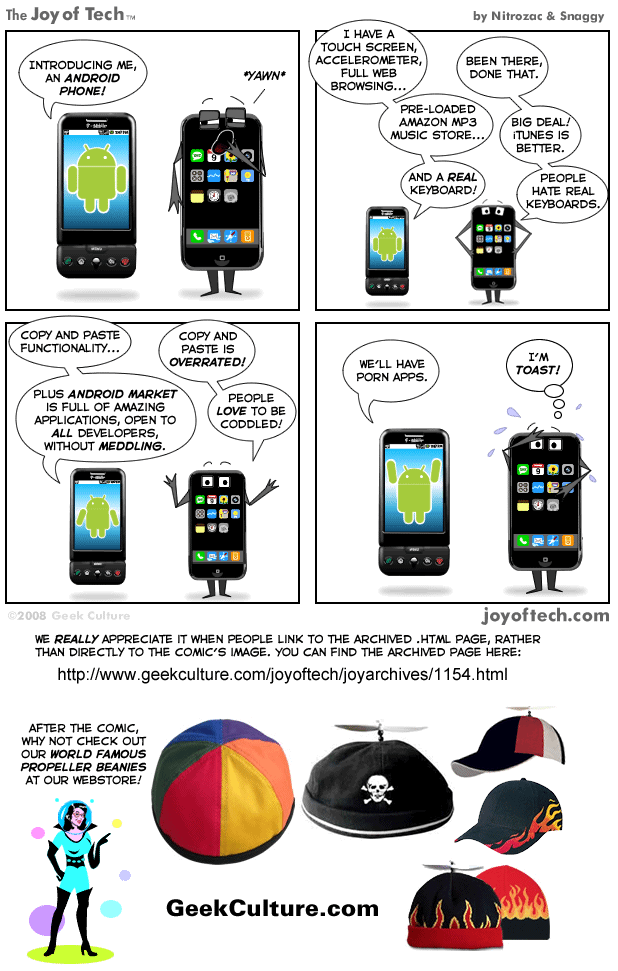
Well if anything, you can’t say there there are too few choices in the Smartphone arena. Joining in the iPhone , Rim, Palm Pre , Windows Mobile firefight, there are now Maemo and LiMo. The later two (Maemo and LoMo) are entering the market just as there is an Android explosion of new phones. And while the Android phones are very tempting my requirements still point me at the Nokia N900, and I think that unless the Vodafone M1/H1 360 doesn’t get traction early, LiMo will be an early dropout.

NOTE: as predicted Vodafone 360 – An Absolute Failure?

Idiotic Marketing by Palm

If this isn’t the most Idiotic Marketing move Palm has ever made, I can’t see how thay could top it. To begin Marketing a second Web-OS phone that is called the Mini-Pre BEFORE THEY HAVE EVEN SOLD A SINGLE ‘PRE’ If there was ever a way to cripple the potential sales surge normally associated with the release of a new Phone, this would be it! Release information about a newer, cheaper version! What were they thinking? Now the ‘Pre’ sales are stunted, as all the people who might have been willing to stretch their wallets in a recession to buy a slick new phone, will now wait for the cheaper model to arrive.

Idiots!

UPDATE: It looks like the Pixie may not happen due to bad planning Palm Pixie Is Real, But May Never Come To Market And not to say so, but I told you so!

Palm Treo Pro Delayed, to be loaded with WebOS?

Everyone is talking up the fact that the Palm Pro has been delayed. When first announced I decried that fact as One more foolish Palm move because it was being created as a Windows 6 device. Claiming that it was diluting a potential ‘Nova’ OS, now Known as WebOS, that was imminent. It should always have been loaded with WebOS, and now maybe it could be. This delay could be the perfect wave for Palm, a touch based Pre , and a non touch version, the Pro, of WebOS.

Apple Slaps down developers again

Every day I’m more and more impressed with my Palm T/X choice as Apple extends iPhone NDA. Apple is getting genuinely proprietary about their iPhone/iPod app store. They are making a mockery of their own developer community and that won’t last, seeing as there is now the Google G1 Android phone and it’s open source development roots.

UPDATE:

Web 2 Bloat and Mobile Internet bandwidth

This article about the Average Web Page Size Triples Since 2003, is a further illustration of problems on the Mobile Internet when dealing with Bandwidth issues. With the nature of the mobile web communication methods (GPRS, EDGE, HSDPA, etc.) being more often costed on the bandwidth, and usage, rather than on a flat rate found in ADSL and Cable connections, this becomes a costly proposition.

Web 2.0 makes for easy universal ‘Application’ programming, but is inherently expensive to use as a consumer while on mobile web systems like Wap enabled phones and PDA’s. Even utilizing a mobile phone as a bluetooth modem and a laptop, Web 2.0 makes for expensive internet.

So the question remains, Who benefits most from Web 2? It surely isn’t the consumer.

I started out developing web pages, often testing against dialup speeds. Who does that now? Who tests their Web 2 apps against a slow GPRS connection or with the dialup connection many Irish folk still have to put up with? There is a vast marketplace out in the real world where broadband, or rather cheap broadband, handicaps Web 2.0 deployment.

This whole Web 2 experience convinces me further of the need to maintain, and further expand, traditional fat client Client Server application development into the mobile internet. As the internet continues to expand into convergent devices like the iPhone, Symbian and Palm OS based smart phones, Portable Media Players and connected PDP’, Web 2.0 will fail to fulfill the promise and the hype currently being displayed.

Apple control of iPhone applications

I think there is a good reason for Apple wanting to control the applications being created and distributed on iPhone and iPod touch systems. Rubbish! In the last week or so, since I have been using my Palm T/X I have been singularly impressed with good applications, and shocked at the pure Rubbish applications that are available to load into my Palm. Mind you, and remember, that many of these applications are legacy from the Palm’s transition from the Motorola Dragonball processors to ARM/XScale CPU’s. And hence face a hardware hurtle that Apple MAY not have to face. Should Apple transition the current ARM iPhone/iPod’s to Intel, they too will face similar troubles. But returning to the control issue, there would be a bit of control over the quality of application development and a maintenance to well defined API that could mitigate future issues. So Apple can maintain a high level ‘feel good’ factor of the iPhone/iPod experience by requiring quality software development. and I believe that the current ‘jailbreaking’ of the platforms will diminish as more and more applications get deployed.

On a separate note, as I mentioned prior, I am impressed with the broad swath, and functionality of the Palm, and also saddened that Palm has, for all intents and purposes abandoned a platform that was so ahead of it’s time.